Text written by Anne Boissière after an interview with Magali Desbazeille,
at her home in Paris, July 26, 2001. As part of Atelier en Œuvre, 2001, Centre Noroit, Arras.
to our great men and our little women
A collaborative protocol performance project
Associated researcher : Caroline Tron-Carroz
Thanks: Christophe Credali, Oana Lohan and Corinne Nieuviarts
Production: Cie ASAP
Duration : to be precised
Places : pedestals in cities across Europe and beyond
About great men, great women and much more!
PIEDESTAL.ES is a collective and collaborative urban performative intervention taking place on pedestals in cities across Europe and beyond.
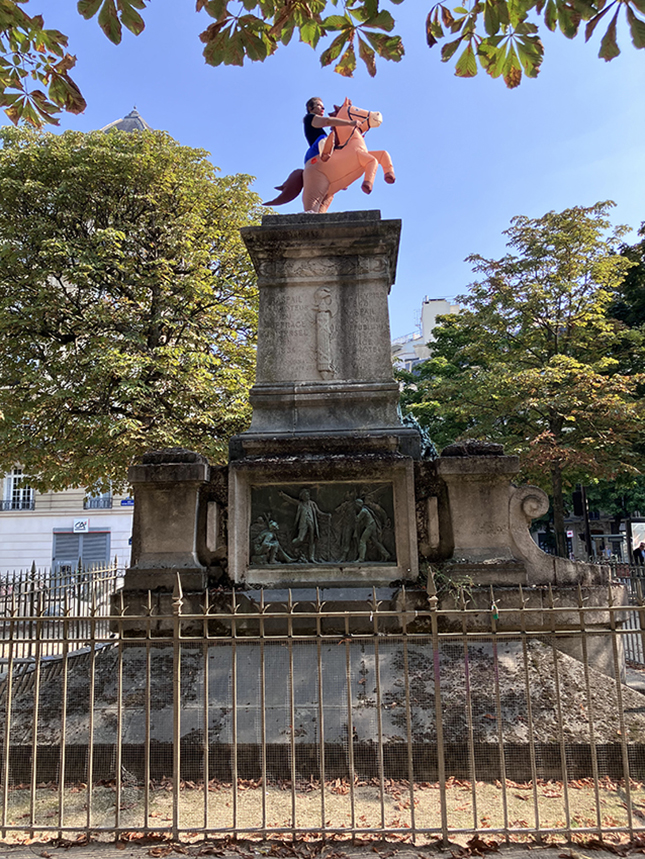
PIEDESTAL.ES is a celebration of a desirable future, based on a historical journey through the statues of “great men”. The performance explores past and future imaginaries of commemoration in public space. This protocol-based performance invites performers to take over the pedestals. Equipped with an inflatable disguise in the shape of a horse, they become ephemeral equestrian statues.
The performers shout out texts recounting the history of the statue that has disappeared or been replaced. They put history into perspective and attempt to celebrate a desirable future! Yes, but which one?
PERFORMATIVES EXPERIMENTATIONS, AUGUST 2025
Pedestal of François-Vincent Raspail, square Jacques Antoine, Paris 14e arr.
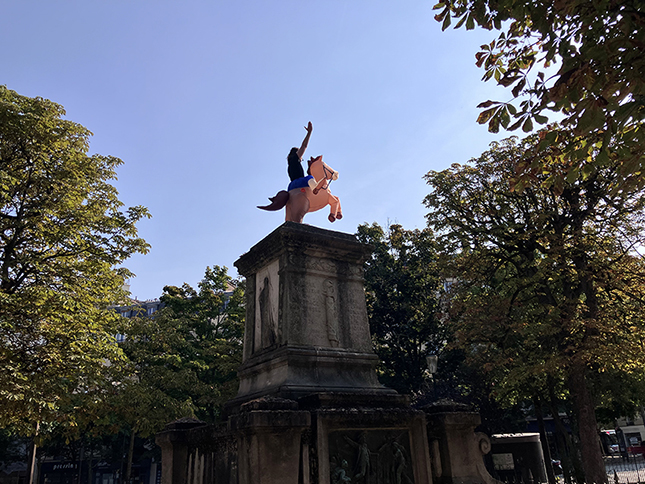
Pedestal of a non-identified allegory, Parc Monsouris, Paris 14e arr.
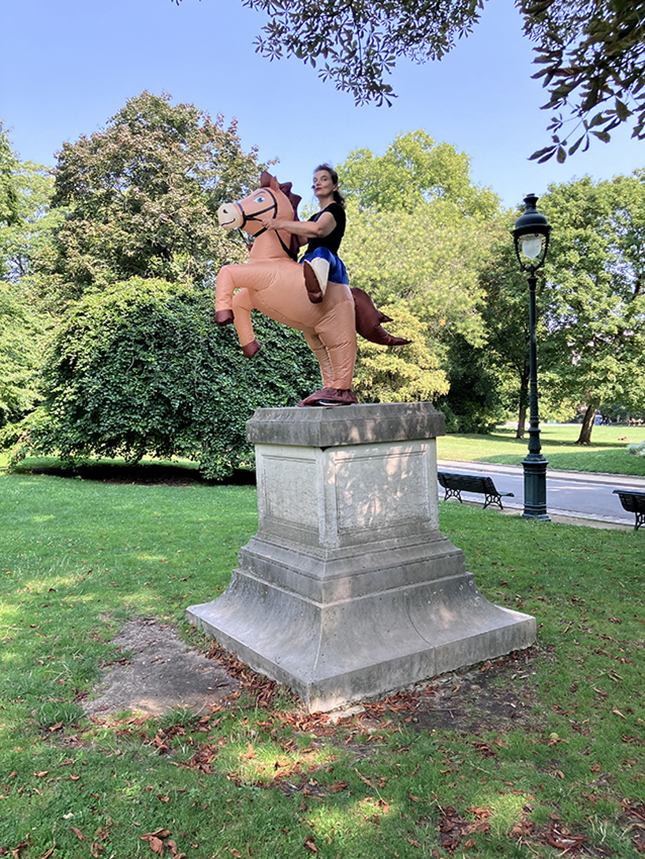
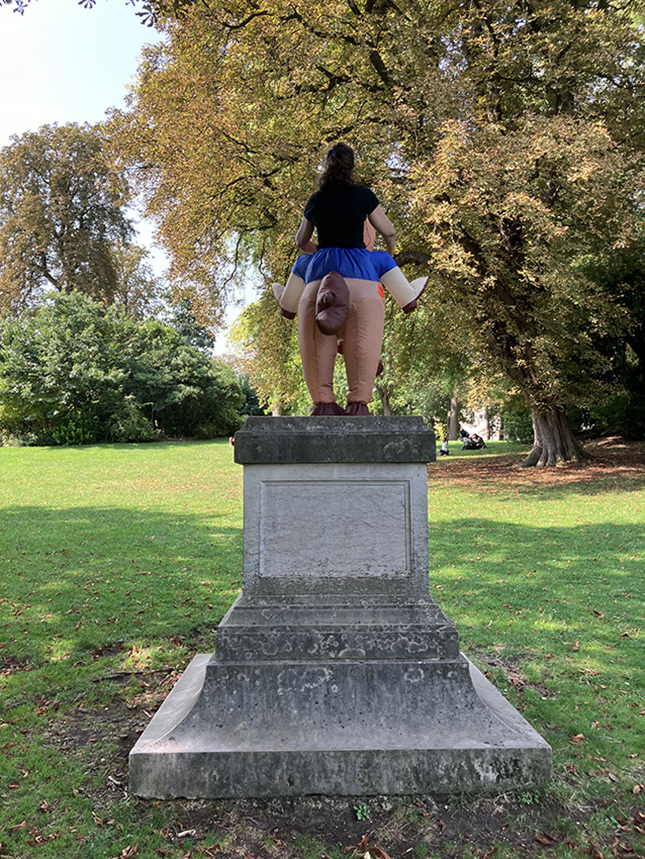
Pedestal of the General Jose de San Martin, Parc Montsouris, Paris 14e arr
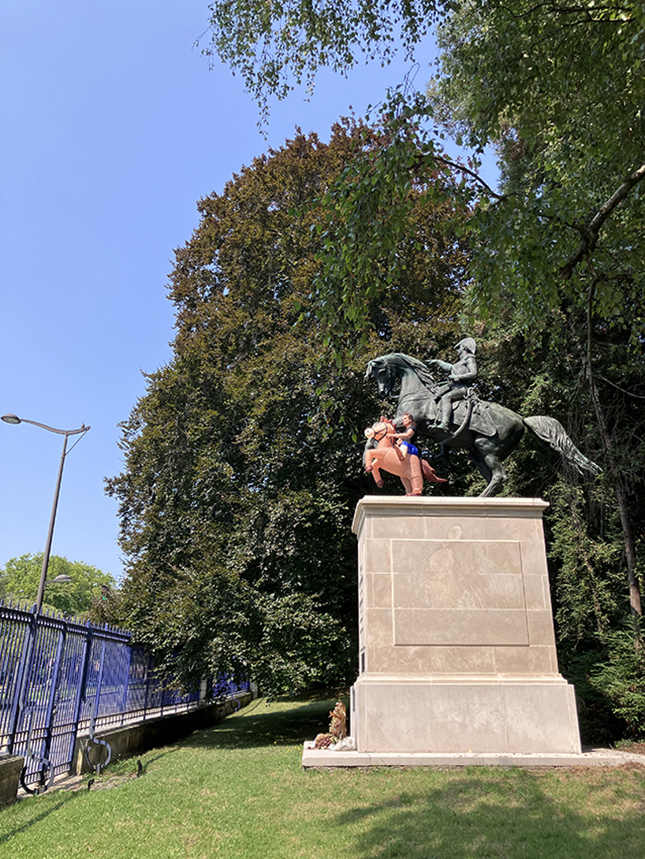
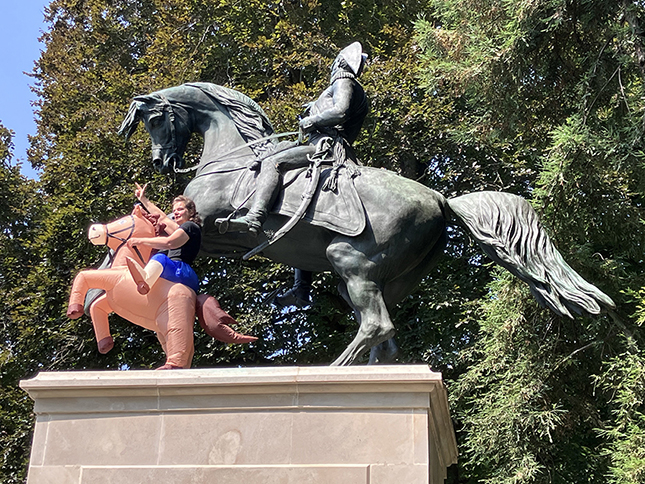
PERFORMATIVES EXPERIMENTATIONS, MARCH 2025
Pedestal of François Arago, place de l’Île de Sein, Paris, 14e arr.
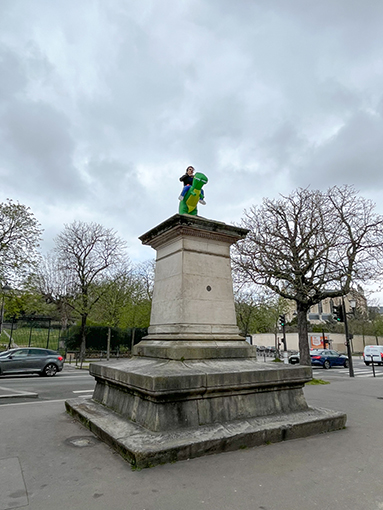
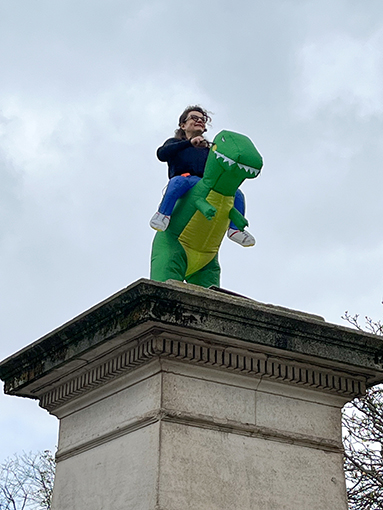

A collective sound work, a performance and a publication
Artistic design: Magali Desbazeille
Artistic collaboration: Julie Valero
Technical direction and sound design: Emilie Zawadzki
Development: Typhaine Le Galès
Ergonomics: Russels Studio
Illustration: Maylis Gérard<
With the participation of students and researchers from the University of Orleans
Executive production: CieASAP – Co-production: University of Orleans
A survey of digital uses and imaginaries among workers, students, researchers in IA

Here, the LINK for the prototype
Sound models of combinatorial poetry
Description
In 2050, when I was 20… takes three artistic forms: a collaborative digital creation at the crossroads of sound art and combinatorial poetry, a performance, and a publication.
In 2050, when I was 20… questions the uses and imaginations of digital technology for their societal and intimate, political and poetic, scientific and imaginary dimensions. In the form of retro-fiction, In 2050, when I was 20… puts into perspective the history of uses, imaginations, and their futures.
What did we think would happen in the year 2000? What are we expecting in 2025? What are our hopes for 2050? How will we view 2025 in a few decades? And in 2050, what models of society will we dream of? How will the internet evolve if 90% of its content is generated by AI? What wonders continue to inspire us? What models of society does AI allow us to dream of?
My intention, in exploring the uses and imaginations of digital technology, is to try to understand and then convey the stories of society that are woven across several generations.
In 2025-2026, Magali Desbazeille is an artist-in-residence at the University of Orleans, where she is conducting researches and workshops with students and researchers.
As an example, here are a few sentences written by the participants during fall 2025:
In 2000, when I was 20, I didn’t think I would find love thanks with artificial intelligence.
In 2000, when I was 20, we believed that digital tools were facilitators. It was positive and we were confident.
In the year 2000, when I was 20, in computer science, we believed that classifying was recognizing.
In 2025, when I was 20, with AI, we thought about what we didn’t want, but we didn’t think about what we did want!
In 2025, when I was 20, my uncle had his cards read by AI.
In 2025, when I was 20, you had to spend a lot of time learning to the machine and then evaluating the machine!
In 2025, when I was 20, the use of ChatGPT widened the gap between students who were already strong and used it wisely, and students who were struggling and had ChatGPT do their homework without understanding it.
In 2025, when I was 20, we believed that the explainability of artificial intelligence results was essential.
In 2025, when I was 20, with automation delegated to machines, there was no respite.
In 2025, when I was 20, the imagination was largely fueled: the magical aspect of LLMs such as ChatGPT was pervasive. The promise was kept.
In 2050, when I was 20, I thought AI would help us rebuild a world destroyed by World War III.
In 2050, when I was 20, I thought AI would change our lives!
In 2050, when I was 20, technology had solved all our problems.
A performance-media
A performance by Magali Desbazeille and Julie valero
Production: Cie ASAP
With the support of Quai des savoirs, Toulouse and Université Grenoble Alpes et du programme lined with Hexagone, scène nationale OPSIS de la SFR Création à la MACI.
About IA imaginaries!
Description
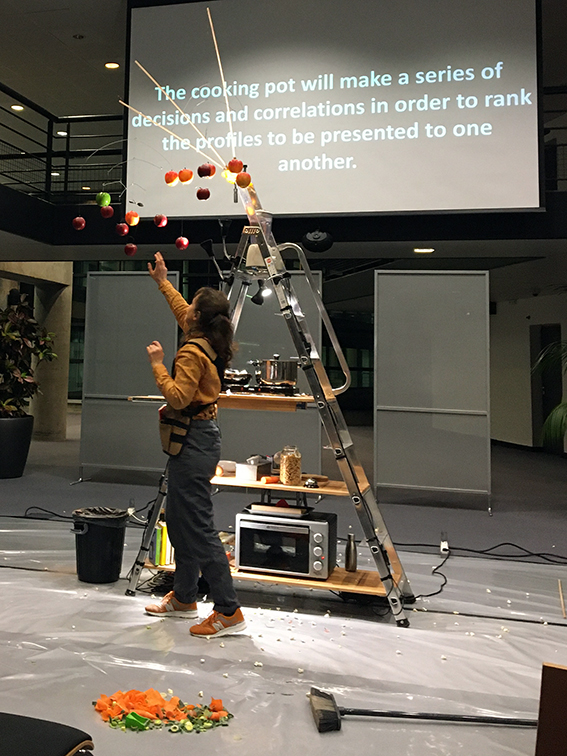
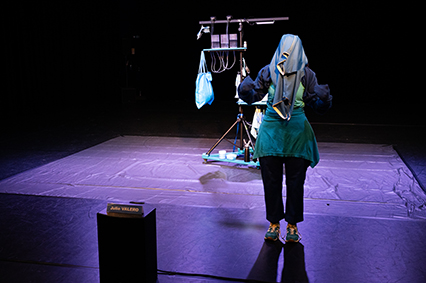
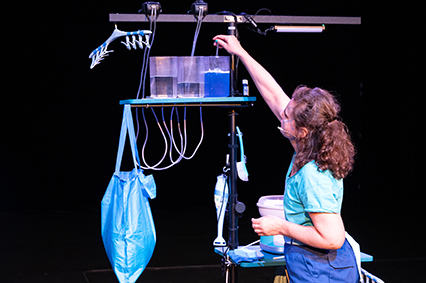
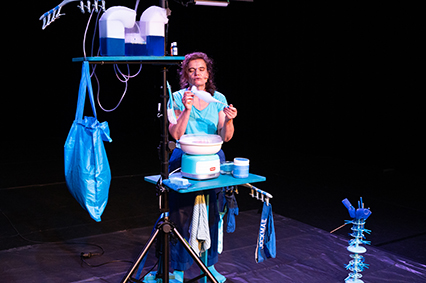
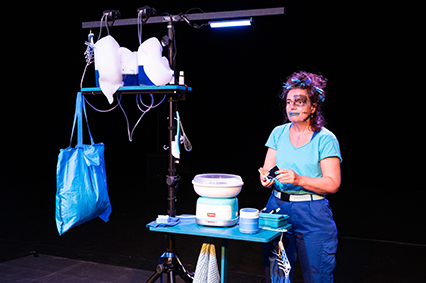
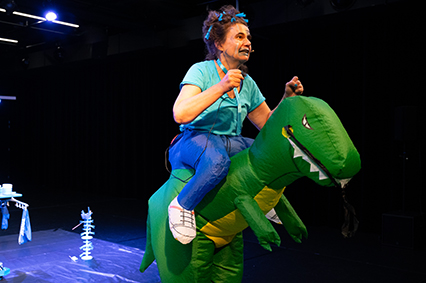
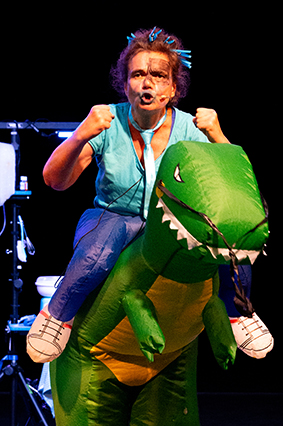
For their new performance, IA, 53 chic and gourmet recipies for the Domsday parties, Magali Desbazeille and Julie Valero continue their live cooking of several artificial intelligences.
After the AIs of everyday life, dealt with in their previous performance, they tackle more gourmet AIs, poised to overturn our social, legal and political norms. AIs that classify, organize, translate, assemble and decide: from decision support to prediction, AI is increasingly becoming an auxiliary to the most complex human activities. What lifestyles do these AIs encourage – those of Silicon Valley engineers only? What models of society do they allow us to dream of?
A performance-medias
A performance by and with Magali Desbazeille
Text: Magali Desbazeille and Julie Valero
Dramaturgy: Julie Valero
Production: Cie ASAP
Translation: Valerie Vivancos
With the support of l’Atelier des sciences, Grenoble, du Quai des savoirs, Toulouse and Université Grenoble Alpes et du programme OPSIS de la SFR Création à la MACI
What about cooking a few AI?
Our recipe
Recipe level: easy
Cost: cheap
Serves 50 to 120
Cooking time: 30 minutes
CO2 cost: unknown
Ingredients:
-4.32 gigs of interviews with computer science, linguistics, sociology, cognitive psychology and ethics researchers.
-3.49 gigs of interviews with engineers from a large IT company and the CEO of a B2B company.
-1.3 kl of cookery books.
-2.8 kl of Artificial Intelligence books
-150g of…
-A pinch of stage writing
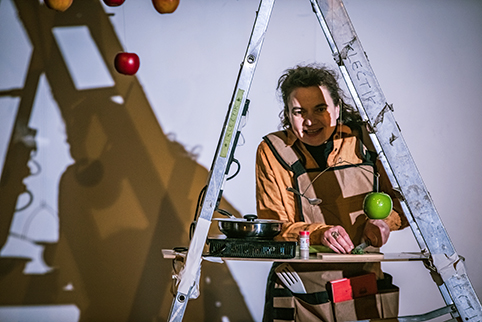
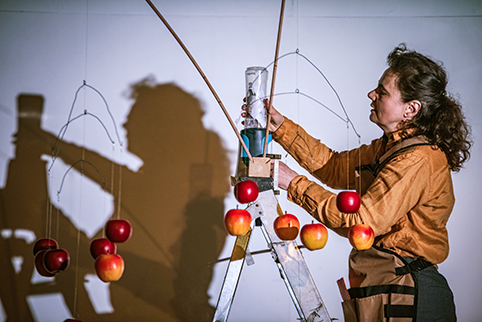
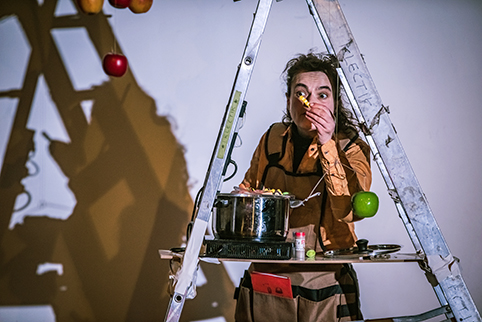
-a stepladder-kitchen
Preparatory steps:
Take two female artists and researchers curious about the apps they deal with in their daily lives. Give them the latest critical studies on the social, economic and legal issues relating to the use of Artificial Intelligences in everyday life, whether it be for love, work, health or leisure. Ask them to meet computer science, linguistics, sociology, cognitive psychology and ethics researchers.
Stir it all up and let it sit for a few months.
Scrape out the “I don’t mind, I have nothing to hide”.
Before placing in the oven, mince the fear and awe.
Bake: 30 minutes locally (no cloud for this recipe).
Leave to cool before removing the mould.
« He or she who codes a system integrates their vision of the world. », Joy Buolamwini, 2016.